Where wood comes from and how it’s harvested matters. How it’s manufactured, transported, and ultimately used matters, too. At Thermory, sustainability isn’t a single step in the process. It’s a commitment that follows every board from the forest to the finished project.
Wood is one of the world’s most beautiful and renewable building materials, but not all wood is sourced responsibly – and not every wood product is manufactured with the same level of consideration for the environment. Deforestation, illegal logging, chemical treatments, manufacturing waste, and transportation emissions all deserve a closer look when evaluating the environmental impact of building materials.
At Thermory, we carefully select our lumber from established forestry regions, avoid tropical rainforest timber, use a completely natural thermal modification process, prioritize efficient transportation, and continually look for ways to reduce waste.
1. It Starts With the Forest: Knowing Where Our Wood Comes From
Responsible sourcing begins long before a tree becomes lumber.
The environmental conditions in which a tree grows have a significant influence on its characteristics. Forest density, soil nutrients, humidity, sunlight exposure, and even a tree’s position within the forest can influence its growth rate, shape, grain structure, and overall quality. These differences matter to us when selecting wood for thermal modification.
At Thermory, we source different species from regions where their natural characteristics make them particularly well suited to our process.
Softwoods: The majority of softwoods suitable for Thermory’s thermal modification are sourced from northeastern Europe, including countries in the Baltic and Nordic regions.
Hardwoods: Most of the white ash suitable for Thermory’s thermal modification comes from Europe and the eastern and northeastern parts of North America.
This isn’t simply about finding lumber wherever it’s available. It’s about understanding the natural characteristics of different forests and selecting the right material for the right application. Our global sourcing model also provides flexibility. By working with multiple established sourcing regions, we can avoid placing excessive harvesting pressure on any one area and account for environmental and biological threats that affect individual species.
For example, the emerald ash borer beetle has significantly affected ash populations in North America. Having access to responsibly sourced ash from multiple regions helps provide greater sourcing flexibility.
2. Why Avoiding Tropical Hardwood Matters

Tropical hardwoods are often selected for outdoor projects because of their natural density, rich color, and resistance to decay, but their performance characteristics don’t tell the whole story.
Tropical rainforests are among the most biologically diverse ecosystems on the planet. They store enormous amounts of carbon, regulate regional and global climate systems, and provide essential habitats for countless species. The scale of the environmental threat is difficult to ignore.
According to an Associated Press report examining the future of the Amazon rainforest:
- Approximately 17% of the Amazon has already been cleared.
- Forest degradation affects approximately 40% of the Amazon, driven by factors including wildfires, logging, and drought.
- A 2024 study published in Nature estimated that 10% to 47% of the Amazon could face multiple environmental threats by 2050, potentially resulting in major ecosystem changes.
Scientists have also warned that losing more than 20% of the Amazon, combined with continued global warming, could trigger widespread ecological changes. Researchers emphasize that the precise tipping point remains uncertain.
These aren’t just numbers on a page. They represent an ecosystem under significant pressure. Illegal logging makes the situation even more complicated.
A particularly revealing investigation published by WIRED, titled Chasing the Illegal Loggers Looting the Amazon Forest, followed an Environmental Investigation Agency effort to expose illegal timber harvesting in the Peruvian Amazon.
Investigators discovered that documentation identifying supposed logging locations often didn’t match what existed on the ground. In some cases, inspectors visited the locations listed on official paperwork and found no evidence that the trees had ever grown there. The investigation took more than four years and involved hundreds of people working across multiple countries. Ultimately, one ship responsible for transporting millions of pounds of illegally harvested wood into the U.S. market was stopped. It’s an important example of how difficult it can be to establish the true origin of tropical timber, even when documentation appears legitimate.
Responsible sourcing requires accountability throughout the supply chain. We believe there’s no reason to rely on tropical hardwoods when responsibly sourced alternatives can deliver the durability and appearance today’s projects demand.
Thermory’s thermally modified white ash offers a compelling alternative. With its rich color, natural grain, dimensional stability, and Class 1 durability classification, Thermory Benchmark Ash provides the performance characteristics designers and builders seek in demanding exterior applications. It also offers an important sourcing distinction: our white ash comes from European and North American regions, not tropical rainforests.
3. A Naturally Different Process: Heat and Steam, Nothing Else
Where wood comes from is important. How it’s treated matters just as much.
Many conventional wood-preservation methods rely on chemical preservatives to protect against decay and insects. Other building materials incorporate plastics, resins, or synthetic binders.
Thermory takes a different approach.
Our thermal modification process uses only three things:
- Heat
- Steam
- The expertise of our wood scientists
No added chemical preservatives. No plastics. No biocides or heavy metals.
During thermal modification, carefully controlled heat and steam permanently change the wood’s chemical composition and physical properties. As the wood undergoes modification, its equilibrium moisture content decreases. This helps reduce moisture-related expansion and contraction, improving dimensional stability. Depending on the species and modification process, thermally modified wood can experience approximately 40–50% lower equilibrium moisture content than untreated wood.
The process also improves resistance to fungal decay when the appropriate modification level is achieved. The result is 100% real wood with enhanced performance characteristics—without relying on conventional chemical wood preservatives. Unlike a surface-applied treatment, thermal modification changes the wood itself. We don’t coat wood to make it perform differently. We enhance the wood from the inside out.
4. Global Sourcing, Thoughtful Transportation

Sourcing wood responsibly also means considering how it travels.
Thermory operates an international supply chain because different tree species grow best in different regions. Rather than forcing sourcing into a single geographic area, we select wood based on its natural suitability, quality, and responsible availability. Once selected, our lumber is transported to our exclusive thermal modification chambers in Estonia, where it undergoes processing before being shipped by water for distribution.
Why water? Because freight transportation methods have very different energy requirements.
According to the U.S. Environmental Protection Agency’s Efficient Transportation report, inland marine transportation can move one ton of freight approximately:
| Transportation method | Miles per gallon of diesel, per ton of freight |
| Inland marine | 675 miles |
| Rail | 472 miles |
| Truck | 151 miles |
Based on these figures, inland marine freight moves the same ton of cargo approximately 4.5 times as far as trucking on an equivalent amount of fuel. These figures are specific to inland marine transportation, rather than Thermory’s individual overseas shipping routes, but they demonstrate why water-based freight is an important part of more efficient transportation systems.
For Thermory, shipping by water is an established part of our distribution strategy.
5. Making Every Board Count: Reducing Manufacturing and Installation Waste
A tree is a valuable natural resource. Using it responsibly means making the most of the lumber we harvest, which is why quality control and manufacturing efficiency are so important.
Our lumber partners understand that our standards are high. Before a board becomes a finished Thermory product, it undergoes inspection, testing, trimming, machining, and thermal modification.
At our manufacturing facilities, advanced technologies help improve consistency and material utilization.These include X-ray screening, laser grading, and precision CNC processing. The goal is to identify quality issues early, optimize the usable material, and deliver boards that are straight, smooth, and ready for installation. But our commitment to reducing waste doesn’t stop when the wood leaves the factory.
Our JEM (Joint End Matched) installation solutions are designed to help installers use more of the material they purchase.
Traditional decking installation often requires board joints to land directly over joists. Depending on project dimensions, this can result in additional cutting and discarded material. JEM profiles allow properly installed board joints to connect between joists, offering greater flexibility in board layout and reducing unnecessary offcuts. It’s a small detail with a meaningful impact when multiplied across larger installations. (And truthfully, our wood is too good to waste!)
6. Durability Is Part of the Sustainability Equation
A responsible building material should be evaluated not only by how it is produced, but also by how long it performs.
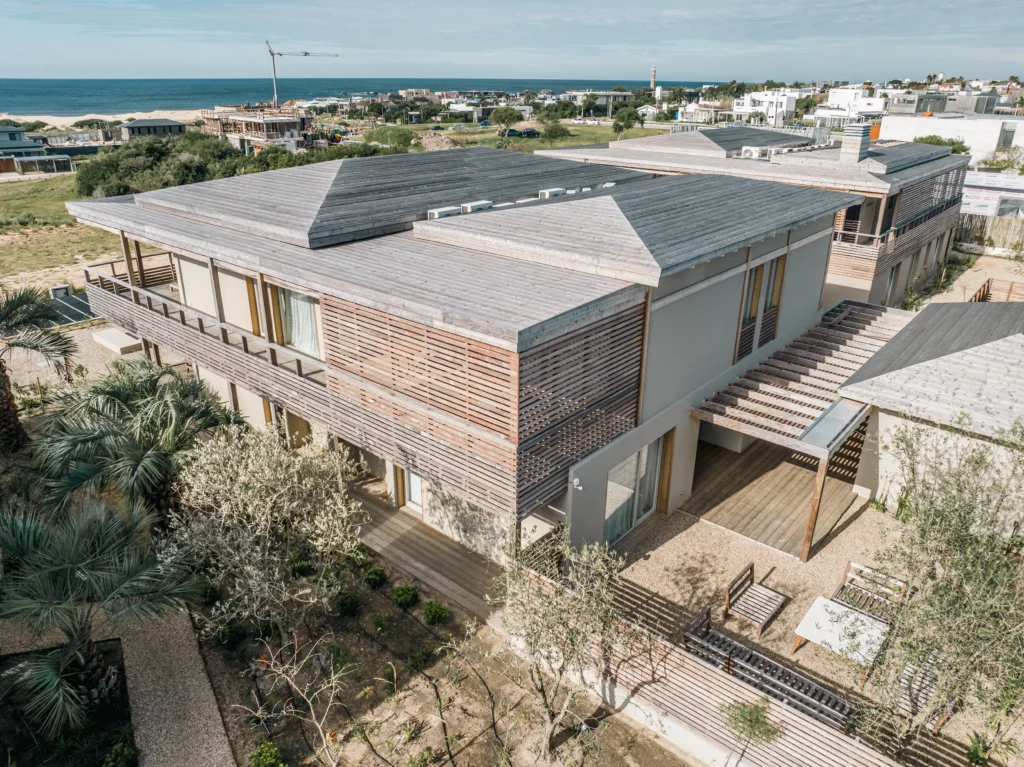
Premature replacement means additional harvesting, manufacturing, transportation, and installation. The longer a material can reliably serve its intended purpose, the more opportunities there are to avoid those repeated resource demands. This is one of the reasons we invest so much in thermal modification.
Thermory Benchmark Ash, for example, achieves a Class 1 durability classification under the EN 350 durability system, supported by independent testing. Explore all of our reports here.
Class 1 is the highest natural durability classification, indicating very durable wood. For appropriately specified and installed Thermory ash products, this corresponds to a reported 25+ years of rot resistance.This makes thermally modified ash a very compelling option for exterior decking and cladding applications where long-term performance matters. Of course, longevity also depends on installation details, exposure, drainage, and maintenance. Proper installation and care are essential to achieving the expected service life. But the principle remains: choosing a durable material is an important part of using natural resources responsibly.
7. Transparency Through Documentation
Environmental documentation, sourcing certifications, and third-party testing are important parts of the Thermory story. For architects, builders, and specifiers, these resources provide information that can be used to evaluate materials and make informed decisions.
Some of the documentation available for applicable Thermory products includes:
Environmental Product Declarations (EPDs)
EPDs provide standardized, independently verified information about a product’s environmental impacts throughout defined stages of its life cycle. They help architects and specifiers compare materials using documented environmental data.
Forest Stewardship Council (FSC) and PEFC certifications
These recognized certification systems support responsible forest management and supply-chain accountability for applicable wood products.
Health Product Declarations (HPDs)
HPDs disclose product ingredients and associated health-related hazard information, helping project teams understand what is in the materials they specify.
Living Building Challenge Red List Free documentation
Applicable Thermory products have documentation supporting their evaluation against the International Living Future Institute’s Red List requirements.
These resources make it easier to look beyond appearance and performance and understand the environmental considerations behind a material. Thermory aims to be fully transparent for our customers, always.
8. Responsibility Doesn’t End at the Finish Line

Throughout forest selection, wood inspection, processing, thermal modification, transportation, and installation – every decision along the way presents an opportunity to use resources more thoughtfully.
At Thermory, that means:
- Sourcing wood from established forestry regions in Europe and North America, never tropical rainforests.
- Selecting species based on their natural characteristics and suitability for thermal modification.
- Using only heat and steam in our modification process, without added chemical preservatives or plastics.
- Processing wood in Estonia and using water-based shipping for distribution.
- Investing in manufacturing technologies that improve quality and material utilization.
- Developing installation solutions that help reduce unnecessary waste.
- Creating durable wood products designed for long-term performance.
Wood is a remarkable natural resource. Our responsibility is to treat it that way. Explore Thermory’s wood products, environmental documentation, and sourcing practices to see what’s behind every board.
Sources:
U.S. Department of Energy, U.S. Department of Transportation, U.S. Department of Housing and Urban Development, and U.S. Environmental Protection Agency, Efficient Transportation: An Action Plan for Energy and Emissions Innovation, December 2024, p. 24.
Larson, Christina. “The Amazon Rainforest and Its Potential Tipping Point.” The Associated Press.
Conniff, Richard. “Chasing the Illegal Loggers Looting the Amazon Forest.” WIRED.