Let’s Take a Closer Look.
As thermally modified wood becomes more widely recognized in North America, one question comes up more often: Why doesn’t Thermory USA operate a kiln in the United States?
On the surface, it may seem like a straightforward step: move production closer to the market. In reality, our answer is rooted in material science, global sourcing strategy, equipment scale, and decades of controlled process development. Our approach is intentionally different because it is built around one priority: consistency at the highest level of performance.
A Global Raw Material Strategy, Not a Local One
We are a global producer, not a regionally dependent manufacturer. One of our core strengths is our ability to source the best raw material from multiple regions around the world, including North America, Scandinavia, Northern Europe, and even the Pacific region such as New Zealand.
This matters because thermal modification is not just about heat; it’s about how specific species respond to heat, pressure, and moisture reduction. A narrow domestic feedstock would limit both performance potential and long-term sustainability.
As Thermory USA CFO and co-founder Mark Challinor explains:
“We use smaller amounts of North American wood, so it makes more sense to have the kilns in Europe. As a large, experienced global producer, Thermory sources the best raw material from all over the world.”
This global sourcing model allows us to prioritize species selection based on performance, not geography.
The Changing Reality of North American Ash

One of the biggest structural shifts we’re seeing in the North American wood market is the decline of ash. Due to widespread environmental pressures, the supply of North American ash has become increasingly limited.
Meanwhile, ash remains abundant and consistently available in parts of Europe, where we have long-established supply chains and processing expertise. That stability is a key reason why we center large-scale thermal modification capacity there, rather than duplicating it in smaller, fragmented regional facilities.
When supply becomes constrained, many domestic producers are forced to pivot species. In recent years, we’ve seen a shift toward alternatives such as red oak, southern yellow pine, and poplar. But that shift introduces new technical challenges.
Why Red Oak Changes the Equation

Red oak is widely available in North America, but it is also one of the more difficult hardwoods to thermally modify successfully at scale.
Compared to ash, red oak is more prone to checking, internal stress, and dimensional instability during high-heat modification cycles. Achieving consistent, structural-grade performance requires extremely controlled conditions and advanced kiln systems.
Challinor notes:
“Red oak is more difficult to thermo-treat, more likely to have checks and splits, and no one other than Thermory has been able to achieve a Class 1 durability with red oak.”
That’s a key differentiator for us. Our European facilities are engineered to manage these variables at industrial scale, enabling performance outcomes that are difficult to replicate in smaller or less controlled environments.
Scale Matters: Our Kiln Infrastructure
Another important distinction is scale—not just of production, but of process consistency.
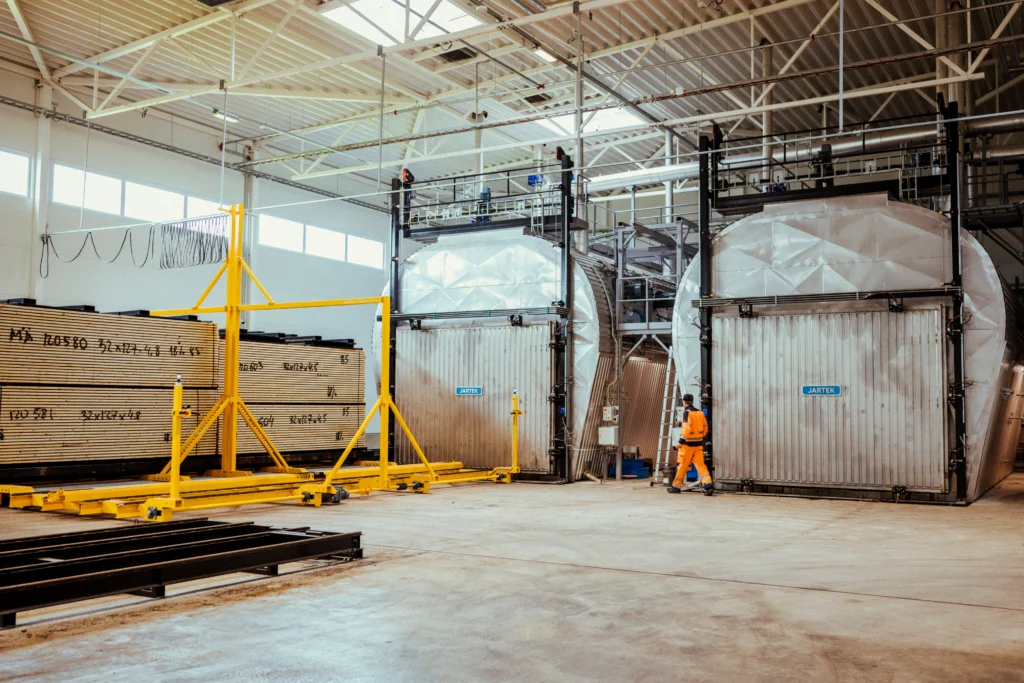
- We operate one of the most advanced thermal modification infrastructures in the world, including:
- 4 large custom Jartek kilns at our Loo factory
- 3 additional kilns in Loo
- 4 kilns in Reola
- Additional kiln capacity in Finland
These are not experimental or entry-level systems. They are large-scale, industrial-grade kilns designed for repeatability, precision, and continuous production.
By comparison, smaller kiln setups used by newer domestic producers are often significantly lower capacity. While they may be sufficient for regional output, they operate on a very different scale of throughput, control, and process refinement.
Indoor vs. Outdoor Processing: Why Environment Control Matters
One of the most overlooked aspects of thermal modification is the environment in which it takes place.
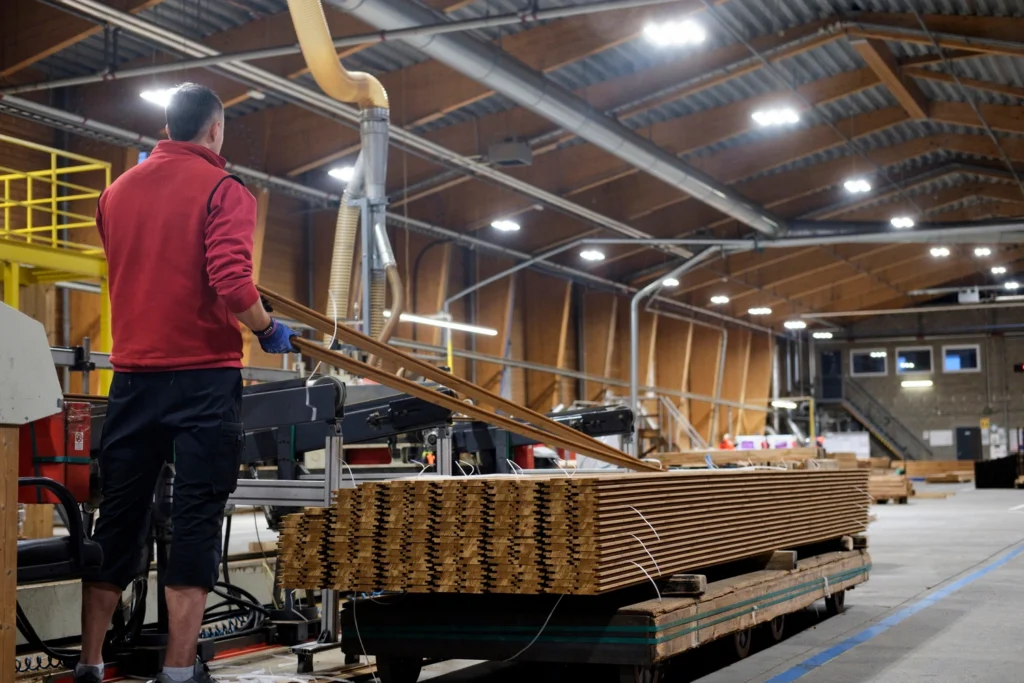
Our newest thermo-plant in Loo is fully enclosed and climate-controlled. This allows wood to acclimate before entering the kiln process, reducing stress and improving consistency throughout the cycle.
In contrast, outdoor kiln operations are exposed to seasonal variability. In colder climates, incoming boards may be frozen or heavily temperature-shifted before entering the kiln. That variability can introduce challenges such as uneven drying, internal stress gradients, and increased risk of checking or splitting. Controlled indoor environments reduce these variables significantly.
Challinor adds:
“Having a controlled indoor environment allows the wood to acclimate before it goes into the kiln. That reduces stress on the material and creates a more consistent, predictable result.”
It’s Not Just the Kiln: The Entire System Matters
While kilns are an essential part of the process, they are only one piece of a much larger system.
Cristian de Rosa, Thermory USA CEO, explains:
“The kiln, though important, is just an ingredient in Thermory’s secret recipe. Selection of the highest graded materials from trusted, sustainable suppliers lets us begin our modification process with great material. Pairing that with our (obsessive) attention to quality and detail, along with our decades of experience, allows us to set the gold standard in what thermally modified wood should be. There are no ‘bad batches’ when it comes to Thermory.”
Summary: Three Main Reasons Why We Haven’t Shifted Kiln Production to the U.S. (Yet!)
When viewed through the lens of efficiency alone, building a kiln in the U.S. might seem logical. But our model is not based on proximity, it’s based on optimization.
To recap, there are three key reasons we center our thermal modification in Europe:
- Feedstock alignment: The species available at scale in North America today don’t always align with our performance standards, especially as ash supply declines.
- Process control and scale: Our kiln infrastructure is significantly larger and more integrated than typical domestic setups, allowing for tighter control and greater consistency.
- Material stability before processing: Indoor acclimation and controlled environments reduce variability before wood even enters the thermal modification cycle.
Mark Challinor summarizes our philosophy:
“We don’t build around convenience. We build around consistency, performance, and the best possible outcome for the material.”
That philosophy guides how we operate today, and why Europe remains the right place for our thermal modification process right now. As markets evolve, material availability shifts, and new opportunities emerge, we’ll continue to evaluate what best supports the consistency and quality Thermory is known for. If that ever includes expanding thermal modification capacity closer to the North American market, it’s something we would thoughtfully consider.
And in thermally modified wood, consistency is what ultimately defines quality. Explore our collection.
Photo Credits: Marita Mones. 501 Studios, Levi Ellyson.